This guide will provide steps on how to use the new AI-Powered Matching Feature inside QB Sync Made Easy to avoid duplicates during your Salesforce QuickBooks integration. This tool helps you match records, review differences, and prepare clean data for your QuickBooks and Salesforce sync. Whether you’re using a Salesforce connector by QuickBooks or managing Salesforce and QuickBooks Online integration, this process keeps everything clear and easy to handle.
How the AI-Powered Matching Feature Works
This feature has been designed to be simple, scalable, and extremely user-friendly. You can choose between uploading your own sheet or auto-generating one directly inside the app.
Option 1: Upload an Existing Excel Sheet
If you already have your Salesforce and QuickBooks data exported:
- Prepare your Excel sheet (Salesforce + QuickBooks fields).
- Upload it into the AI Matching Tool.
- Submit for AI evaluation.
- Receive a full Smart Matching Report via email, containing:
- AI-suggested matches
- Match confidence score
- Records needing manual review
- Records with no match
Option 2: Generate the Matching Sheet within the App
Don’t have a sheet ready? No problem.
You can auto-generate it in seconds:
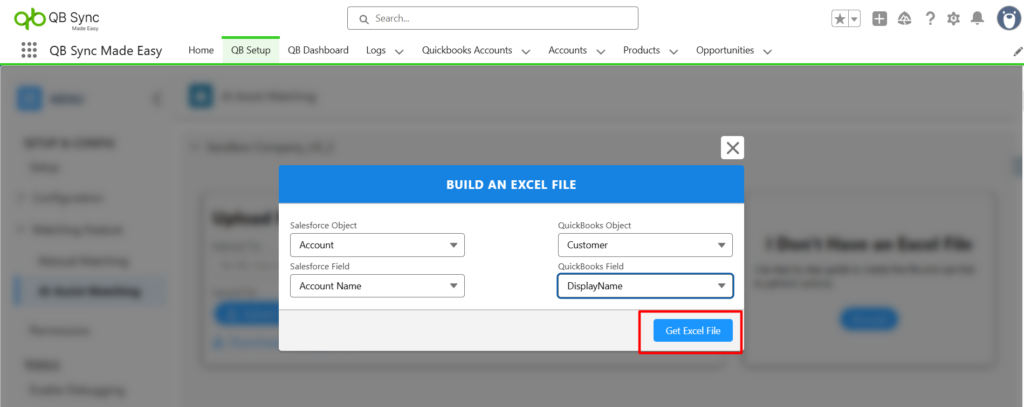
- Select your Salesforce object (e.g., Account).
- Select your QuickBooks object (e.g., Customer).
- Choose one matching key field from each side.
- The system exports a ready-to-upload Excel sheet.
This makes the process seamless even for non-technical users.
Prerequisites
The company must be connected on both sides, and the Pro feature must be enabled.
Steps to Use AI-Powered Matching to Avoid Duplicates
Here are the quick steps to streamline the data flow by removing duplication using the Salesforce QuickBooks integration tool’s AI-Powered matching function.
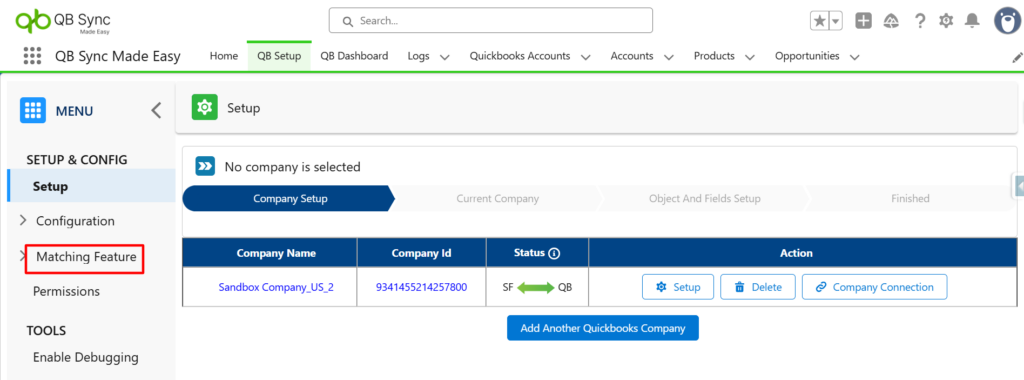
Step 1: Open the QB Setup Page And Click On “Matching Feature” on the Left Side bar.
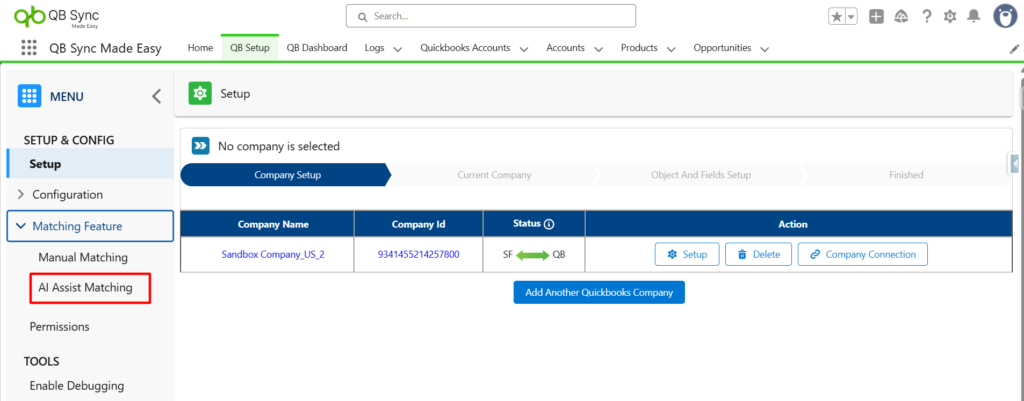
Step 2: Select “AI Assist Matching”
Step 3: Understanding the Input and Output Flow
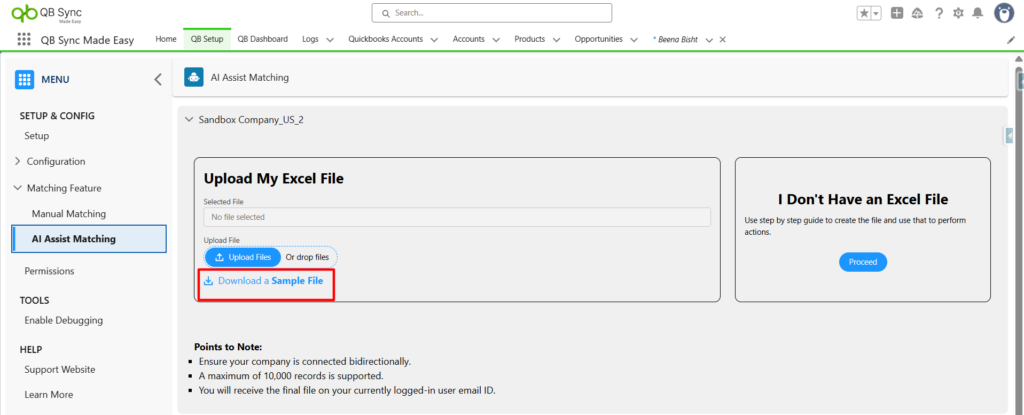
To use this feature, you need to upload an Excel sheet that contains Salesforce and QuickBooks records, such as names, addresses, emails, and other matching fields. After taking the input, the feature compares and matches the provided records. Once the matching process is completed, it generates an output Excel sheet based on the results.
You can download the sample Excel sheet to understand the required format. This example shows the structure your file must follow in order to use this feature.
Explanation of the File Format
The Excel file contains five columns, each serving a specific purpose:
- Salesforce Matching Field 1
Contains the Salesforce reference value used for matching (e.g., an address or name).
- Salesforce ID
The unique Salesforce record ID associated with the matching field.
- QuickBooks Matching Field 1
Contains the corresponding QuickBooks reference value used for matching (e.g., a location or customer name).
- QuickBooks ID
The unique QuickBooks record ID.
- Input Variable
Additional input is required for the process.
In the example, this column includes values like “Customer.”
If the value displays in scientific notation (e.g., 9.34145E+15), it means the number is very large; Excel automatically formats large numbers this way.
Step 4: Generate or upload your Excel data
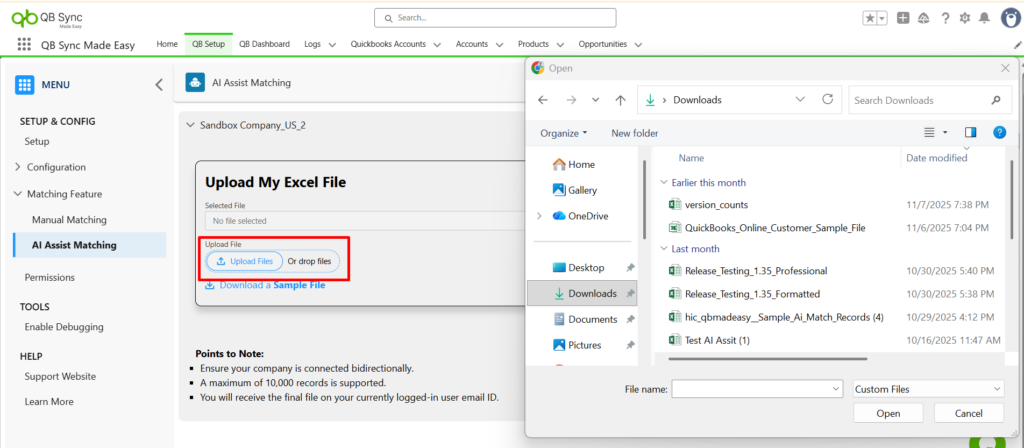
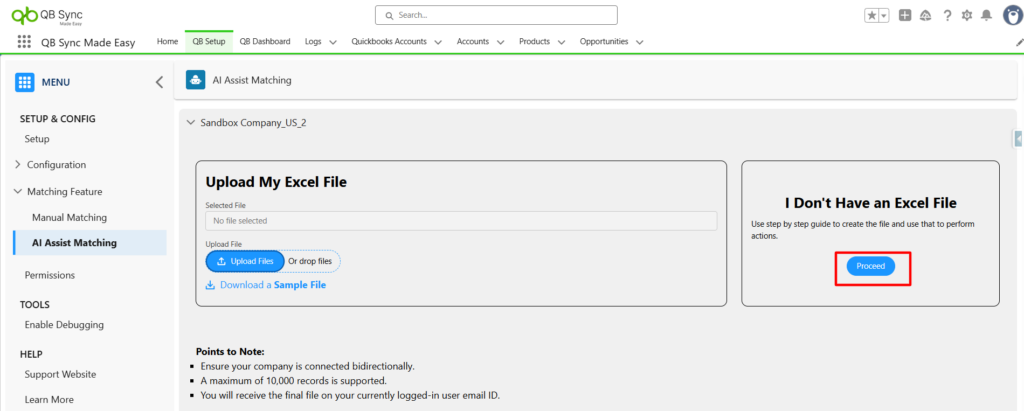
If you want to upload an Excel file from your device
If you want to generate Excel Sheets using the AI Assist Matching feature. Then click on the Proceed Button
After completing the previous step, a dialog box will appear. Fill in all the dropdown fields, then click the Get Excel File button.
Step 5: Submit it for AI matching
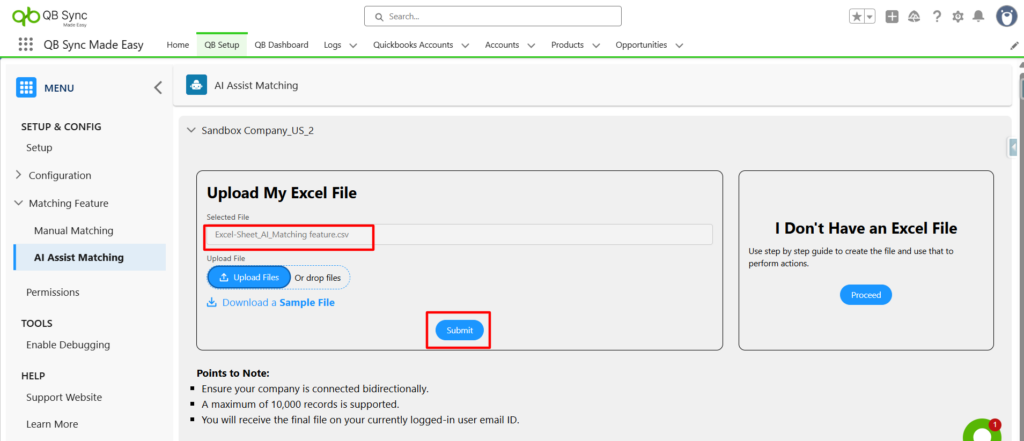
Download the Excel sheet, upload it, and then click the Submit button.
Step 6: Receive your detailed match report via email
After the matching process is completed, an Excel file will be sent to the email address that is connected to your organization. This file will contain three worksheets: Matched, Need Review, and Import.
- The Matched sheet will include the records that were successfully matched.
- The Need Review sheet will contain the records that could not be matched.
- The Import sheet will list the records that can be imported into your organization.
Step 7: Bulk update your Salesforce records using the included import sheet
The Import sheet contains the records that are ready to be added to your organization. You can import this data using the Data Loader. After the import is completed, the QuickBooks ID will be added to your records, allowing both systems to stay synced with each other.
Conclusion
The AI-Powered Matching feature makes Salesforce QuickBooks integration far easier by preventing duplicate data before it enters your system. It helps you match old and new records, clean inconsistencies, and prepare reliable data for QuickBooks and Salesforce sync. With this feature inside the Salesforce connector by QuickBooks, you get a simple and accurate way to manage Salesforce and QuickBooks Online integration without manual cleanup.
If you want a cleaner, duplicate-free sync experience, this AI matching tool gives you everything you need to handle data on both sides.